Posts

Showing posts with the label UVM

Cracking the UVM-Verilator Code: 50+ IPs, AI Guardrails, and the Open-Source North Star

UVM on Verilator Isn’t Impossible. It’s Just Hard. We Did It Anyway. The “standard” line in the industry: UVM and Verilator don’t mix. Enterprise-grade open-source verification is a fantasy. So we put that claim under load. ✔ 50+ production UVCs ported ✔ 35 + non-obvious failure modes uncovered ✔ Converted into UVMLint and SVALint rules ✔ AI guardrails to prevent regressions This post is the why and what; the how and numbers are for the room at Hacker Dojo.  This is production-grade code—the kind that tapes out chips—running on open-source infrastructure. The implication is bigger than a port: Reduced dependency on closed ecosystems. Negotiating leverage with EDA vendors. Strategic control over your verification stack. If you’re a semiconductor company exploring Verilator for serious IP, don’t start from scratch. Start from the team that already mapped the minefield. 📅 Join us at the Hacker Dojo Next Thursday, the AsFigo team...

The AsFigo UVM GitHub Challenge: Earn Your Complimentary UVM Bootcamp Seat

🚀 The AsFigo GitHub Challenge: Earn Your Seat We are looking for committed builders to join us at JCNC on March 1st for the world’s first UVM Verilator Bootcamp. We want to see your UVM fundamentals in action, and in return, we’re offering a path to join us through technical contribution. The Reward We are opening 5 Complementary Seats ($40 value each) for top contributors who demonstrate their work in the open-source ecosystem. The Challenge: Prove Your Build To be eligible for a complementary seat, you must showcase your UVM skills on GitHub: The Content: A public GitHub repository featuring 2 unique, small UVCs (or a mini-environment) you have built. The Proof: Your repo must include a clean file list ( .f ) and a simulation log proving a "Pass" status from any simulator (e.g., EDA Playground). The Deadline: Submit your GitHub link by Sunday, Feb 22nd, 11:59 PM PST . Why Enter? ...

Breaking the License Barrier: The World’s First UVM + Verilator Hands-On Bootcamp - Mar-1, Sunday 3-5 PM PST

Remote link:  AsFigo UVM Verilator Bootcamp | Meeting-Join | Microsoft Teams For decades, the power of UVM (Universal Verification Methodology) has been locked behind the high-cost gates of commercial simulators. At AsFigo , we believe the future of silicon verification belongs to the community. We are breaking those gates down to empower a new generation of verification engineers. A Community Milestone The dream of open-source UVM is the result of a massive, multi-year industry effort. Foundations laid by the CHIPS Alliance, DARPA, Google, and Antmicro have reached a critical tipping point. This movement was fueled by the relentless technical contributions of pioneers such as Wilson Snyder, Geza Lore, Krzysztof Bieganski, et al. , whose work over the last several years made the "impossible" possible. The public breakthrough for UVM support in Verilator was announced in late 2023. On that very day, we at AsFigo successfully ported a complete APB UVC and...

Call for Collaboration: Seeking Public UVM Environments for Verilator 5.0+ Porting

The transition of SystemVerilog UVM environments to open-source simulators presents specific technical challenges. While Verilator 5.0+ has expanded support for various SystemVerilog constructs, the industry still lacks a documented and repeatable path for certain UVM-specific behaviors. In parallel, we aim to curate a public vault of UVM repositories that have been successfully ported to Verilator. AsFigo is initiating a collaborative effort to document these gaps, and we are looking for engineers, researchers, and students to contribute original UVM codebases to this effort.  Link to Google Form: Submit Your code base The Technical Focus This effort intentionally moves beyond minimal or illustrative examples. We are seeking unique, original UVM implementations that reflect realistic UVM environments and non-trivial SystemVerilog usage found in real-world verification flows. Infrastructure Components: Memo...

Driving UVM Quality: Join Our Next UVMLint Meetup in Newbury - Jul 18, 2025

Following the positive reception and thoughtful engagement at our recent technical meetups in Reading and Cambridge , AsFigo is pleased to invite you to our next UVMLint Technical Meetup , taking place in Newbury — a region with a strong footprint in semiconductor design and verification. This free, hybrid event offers a focused technical forum for engineers seeking to enhance the quality and maintainability of their UVM environments through structured linting , metrics analysis , and practical methodology insights . 📍 Event Details Date: Friday, 18th July 2025 Time: 14:00 – 16:00 BST Venue: Oxford House, 12–20 Oxford Street, Newbury, Berkshire, RG14 1JB Meeting Room: Donnington Register at:   https://forms.gle/VCiVEiKgzKJgPiAD8  Remote Access:   Join the meeting now: https://teams.microsoft.com/l/meetup-join/19%3ameeting_OGNiY2RjYzEtNGI0OC00MDg3LTk2OGYtZGZiZWMzNTQyMGQ1%40thread.v2/0?context=%7b%22Tid%22%3a%22ce8c6d03-7521-4120-aa04-...

Join Us in Cambridge - Advancing Chip Verification with UVMLint & SVALint

AsFigo invites you to our next technical session, focused on enabling semiconductor design teams to adopt open-source EDA tools—especially for testbench linting workflows. Remote-dial-in link:  UVMLint meetup - Cambridge, June 27 | Meeting-Join | Microsoft Teams 📍 Event: UVMLint & SVALint – Enablers to Move Your Chip Design Ahead 📅 Date: Friday, June 27, 2025 🕙 Time: 10:00 AM to 12:00 Noon (UK Time) 📌 Location: Wellington House, East Road, Cambridge, CB1 1BH, United Kingdom ☎ Phone: +44 1223 451000 🌐 Format: Hybrid (in-person & remote via Microsoft Teams) 💡 Cost: Free (registration required - https://forms.gle/upzLGyWJbRnbgRzU7 ) After a successful SVALint session in Reading, UK, we’re bringing this discussion to Cambridge—one of the UK’s most active semiconductor hubs. This event is geared toward engineers working in UVM based verification, formal verification, and testbench architecture using UVM and SVA. Ag...

Waves2UVM - an opensource bridge between Formal & UVM

Image
Waves2UVM is an app within the Go2UVM ecosystem that aids in the automatic generation of UVM testbenches from waveform data. This is especially valuable for engineers aiming to accelerate the design verification process of complex hardware systems. The tool works by translating waveform dumps (which capture signal behavior during simulations) into UVM verification components, thereby eliminating the manual coding typically required for testbench creation. The key advantage of Waves2UVM is its ability to work with formats like WaveDrom , offering a streamlined path from a structured, waveform data to a functional UVM testbench, which can be utilized within broader UVM verification flows. This improves productivity in hardware verification by reducing errors introduced during manual coding and speeding up the overall verification cycle. A recent customer usage of this handy technique deals with reproducing Formal Verification traces in simulation world. As Formal Verification tools such ...

Contributing to UVM-MS LRM through public review prcoess

Our Director of Verification, Ajeetha Kumari took part in offering her review comments based on her decades of AMS design verification experience to Accellera's UVM-MS standard.  Overall, our focus is on  clarity, correctness, good coding practices, and ensuring UVM-MS follows standard verification methodologies .    Clarifications and Expansions Suggested explicitly stating IEEE 1800.2 UVM version to avoid ambiguity. Asked whether VHDL should also be considered in addition to SystemVerilog. Recommended good coding guidelines for UVM-MS lint rules . Pointed out grammatical issues , such as removing unnecessary "s" in certain words. Suggested formatting improvements, such as italicizing specific terms . Code and Implementation Improvements Recommended ensuring all UVM components/agents are in separate packages for better reuse. Questioned the lack of UVM factory registration for some proxy classes. Suggested adding function prototypes (like ne...

Customizing UVMLint for IEEE 1800.2 Base Class Library

Image
Universal Verification Methodology (UVM) stands as the pinnacle of design verification methodologies in the ASIC and FPGA domain. The integration of linting and static code analysis has emerged as a vital practice, particularly in projects with broad user bases, extended lifetimes, and distributed development teams. Recently, during the UVM IEEE 1800.2-2023 release cycle (at DVCon US 2024), the potential for a custom UVMLint solution to enhance the UVM Base Class Library (BCL) development process was recognized. Some of the lead developers of UVM BCL suggested to create a simple rule deck that focuses on specific issues seen by the core development team over last few years than a general-purpose linter that may end up throwing 1000s of violations.   At AsFigo, we've taken the initiative to develop custom linting rules tailored specifically for the UVM BCL. Our goal is to offer our community an open-source lint package that can be used by the UVM IEEE committee and the wider devel...

Porting a complete UVC to Verilator + UVM - an anecdote!

Image
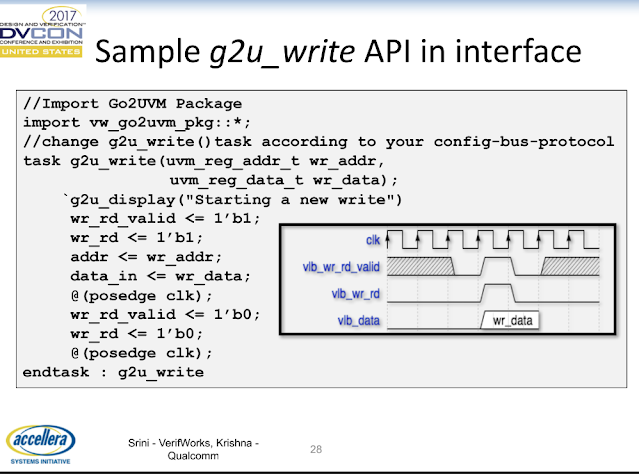
 So, here we are on Day-1 of UVM + Verilator becoming available to the public, start of democratizing chip design verification. In case you just woke-up/started on this topic, read the release of UVM + Verilator with some intricate details on the challenge on the way by Antmicro via:  https://antmicro.com/blog/2023/10/running-simple-uvm-testbenches-in-verilator/  Awesome work by the folks at Antmicro and fantastic support by the ecosystem specifically Western Digital, kudos!  At AsFigo , we are committed to fueling open-source driven chip design and verification. So we took this opportunity to port a commercial-grade UVC (Universal Verification Component or a Verification IP) and ported it to compile and run on Verilator. Below are our reflections from this experiment. Get in touch with us to discuss how AsFigo can help your VIPs and testbenches to be ported to opensource EDA.  Case study: VLBus - a simple peripheral bus intended for write/read to configuration...

UVMLint - why not to "re-declare" is_active inside agent?

Image
 Building on PySlint, UVMLint is adding rules for UVM based testbenches. A recent user reported the following violation: That's just a short reporting, with detailed message to follow (users can add more information at their end with PySlint API soon). Let's understand why this is considered a bad practice in UVM.  To speed things up (and to add spice to it), we used Google Bard on "what is is_active in UVM agent" and below is a response:  The is_active variable in a UVM agent is an enum type of uvm_active_passive_enum . It specifies whether the agent is active or passive. An active agent has a driver and sequencer, while a passive agent only has a monitor. The is_active variable is a useful tool for controlling the behavior of UVM agents. By setting the is_active variable, you can control whether an agent has a driver and sequencer, or whether it only has a monitor. Not bad for a GenerativeAI conversation, isn't? As a quick recap, UVM agent is a specialized c...

Use of "extern" methods in Verification IPs - a PySlint case study

Image
As we prepare for Verification Futures 2023 , Austin event, an enthusiastic user ran PySlint on a small SPI VIP and found the following violation (among others). As expected, first reaction from the user was - what's the big deal? Below is our attempt in rationalizing why this rule is important especially for VIP developers and users.  A quick recap - The extern keyword in SystemVerilog is an optional qualifier to class methods. As in C++, Java and other languages, this is a highly recommended coding style, some benefits include: Improves readability - By declaring the method prototype in one place and the implementation in another, it can be easier to "read" the code for end users (not only the original developers) - to quickly glance the list of APIs/methods without scrolling 1000s of lines of code (if the implementation is mixed with declaration).  To hide implementation details. If the method implementation is defined in a separate file, it can be hidden fr...